
- Council
Agnes Goode: A century of legacy and leadership
07/12/2025
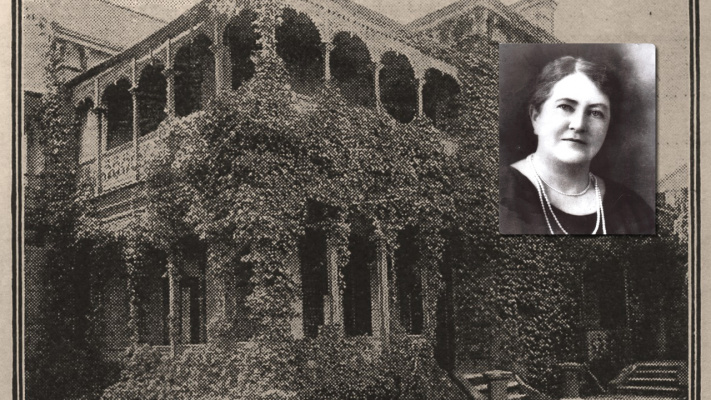
One hundred years on, a pioneering community activist, social reformer and the first woman elected to the Corporation of the Town of St Peters, Agnes Goode’s legacy continues to shape the civic landscape—most visibly through the Agnes Goode Kindergarten in Stepney, which was named in her honour.
Born on 31 January 1872 in Strathalbyn, Agnes Knight Goode (née Fleming) was raised in a family that valued education and civic duty.
After earning a bursary to attend Port Adelaide Model School, she qualified as a teacher in 1893 and began her career in Caltowie, in the state’s mid-north.
In 1896, she married William Goode, a sheep farmer from White’s River near Port Lincoln.
Her move to Adelaide in 1915 marked the beginning of her most impactful public work.
Deeply influenced by the suffrage movement, Agnes became a vocal advocate for legal justice and representation for women and children.
She believed that law reform should permeate all aspects of civic life, championing causes such as early childhood education, the appointment of female police officers, and equal guardianship rights for women.
During World War I, Agnes emerged as a key figure in the ‘Win-the-War Campaign’, serving as Vice-President of the Women’s State Recruiting Committee.
Her leadership and eloquence were widely recognised and in 1917 she was appointed a Justice of the Peace along with 13 other women.
Like Agnes, many were from the State Children’s Council.
By 1919, Agnes was presiding over South Australia’s State Children’s Court and serving on the National Council of Women.
Agnes Goode’s political ambitions were as bold as her convictions.
In 1924, she became a parliamentary candidate, running for the seat of Adelaide under the Liberal Federation banner.
Though unsuccessful she persisted, later standing for a seat on the Adelaide City Council. Her breakthrough came in 1925 when she was elected to the Corporation of the Town of St Peters Council, representing the Hackney Ward.
This historic victory made her the first woman to represent this Council and the local community— a position she held until 1935.
Agnes’ passion for early childhood education led her to help establish the Hackney Free Kindergarten in 1926, housed in the Methodist Mission Hall on what is now Richmond Street.
Her commitment to social welfare extended to her roles as Visiting Justice to the Adelaide Gaol and the Institution for Inebriates (1923–1930), and as an official visitor to the Parkside Mental Hospital (1919–1925).
She also held key positions in the Liberal Federation of Women’s Association, serving as Treasurer, Secretary and newsletter editor.
Another significant acknowledgment of Agnes’ talents was her appointment in 1917 as the female voice on the State’s Advisory Board of Censors for Films.
Importantly, her tireless work earned her a reputation as a formidable and principled advocate who never hesitated to challenge the status quo.
In 1919, Agnes Goode bought a charming home with a wonderful garden on Payneham Road and lived there for nearly three decades.
Agnes passed away on 20 February 1947, but her influence and legacy are very much alive.
In 1949, the Stepney Free Kindergarten in Cornish Street was renamed the Agnes Goode Kindergarten, as a tribute to her enduring contributions to childhood education and community welfare.
As we celebrate the centenary of the election of this remarkable woman who so passionately served our community, we remember Agnes Goode not only as a trailblazer but as a woman whose vision and determination helped shape a more just and inclusive society.
Her story is a powerful reminder of the impact one individual can have—and why her name still resonates in the heart of our community