
- Projects
Revitalising Rosemont Lane: Mitigating flood risk and protecting trees
15/01/2026
Tucked quietly between William Street and Kensington Road in Norwood, Rosemont Lane may seem like an ordinary laneway—but for the residents who live alongside it, this short stretch of road has been the focus of a major transformation.
For years, Rosemont Lane was a privately owned, unsealed laneway servicing 21 adjoining properties.
Eleven of those homes relied on it as their main vehicle access. During heavy rain, however, residents were faced with flooding as a recurring problem.
With no stormwater drainage infrastructure in place, rainwater pooled at the western end of the lane, making it difficult for vehicles to pass and creating ongoing maintenance challenges.
“We are grateful that the Council stepped in to address the increasingly concerning stormwater drainage issue for some of our neighbours but with the primary design focus on the conservation of the magnificent mature trees that overhang the lane,” says local resident Peter Scriver.

Image above: Rosemont Lane (before)
Turning a private laneway into a public road
In 2021, after hearing concerns from local property owners, the City of Norwood Payneham & St Peters commenced the process of converting Rosemont Lane from a private laneway into a public road, in line with the Council’s Private Laneways Policy and the Local Government Act 1999.
Under this policy and legislation, the Council can assume ownership and responsibility for private laneways that have fallen into disrepair—even though it has no legal obligation to do so.
This allows the Council to deliver practical, long-term solutions for drainage, access and safety issues affecting residents and the broader community.
“Private laneways often don’t have a known owner or any formal infrastructure such as kerbing and drainage systems,” says Lisa Mara, General Manager, Governance & Civic Affairs.
“By converting them to public roads, we can bring them up to Council standards, implement essential infrastructure and ensure they are maintained.”
Following consultation with residents, the Council officially converted Rosemont Lane to a public road in June 2022, paving the way for much-needed infrastructure upgrades.
Designing a sustainable solution
With the conversion complete, the Council proceeded to develop a stormwater solution that would address the flooding problem without compromising the local environment.
A unique challenge presented at Rosemont Lane is six mature Red Gum trees growing along the northern boundary. Located on private property, these trees are ecologically and aesthetically significant to the local streetscape and preserving their health was a key priority.
The Council’s City Arborist was involved throughout the process to ensure that any works close to the trees did not damage their roots or prevent oxygen access to the soil.
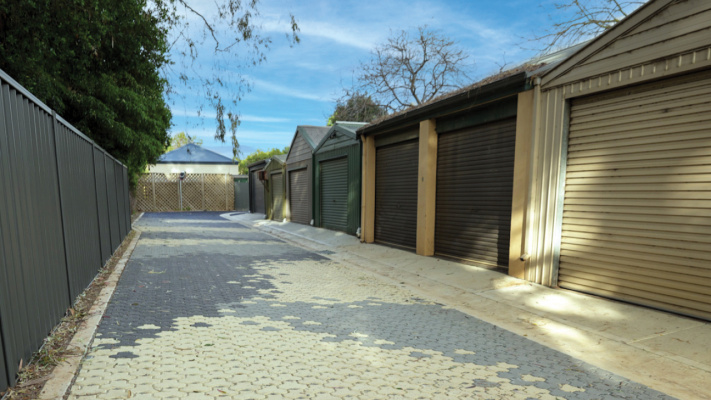
As a result, the Council opted for an innovative, environmentally sensitive approach using permeable interlocking pavers instead of traditional asphalt or concrete.
This surface treatment allows rainwater to seep through, supporting stormwater management while maintaining airflow and moisture for the Red Gum roots. It’s a ‘soft’ drainage solution that reflects the laneway’s low-traffic, residential character.
“Permeable paving is a great example of sustainable urban design,” says Project Manager, Stuart Pope.
“It manages water naturally, reduces runoff, and helps protect the health of mature trees.”
What the upgrade includes
The reconstruction of Rosemont Lane has delivered a major upgrade to both infrastructure and safety. Key components of the project include:
- construction of an underground water storage system and pump station;
- installation of a rising main and new power supply for the pump station;
- permeable paving adjacent to significant trees;
- concrete kerbing and new asphalt surfacing;
- a new pedestrian footpath and driveway crossover; and
- additional drainage outlets along Rosemont Street.
To manage excess rainwater, an infiltration basin has been constructed at the western end of the lane. This underground feature collects and stores stormwater before it slowly soaks into the surrounding soil. The basin—approximately one metre deep and filled with crushed rock— will help reduce flooding while naturally replenishing groundwater.
“The construction was carried out professionally and I’m pleased with the result. With the recent inclement weather, I can see that the stormwater infrastructure is doing exactly what it's intended to do,” adds Mr Scriver.
A collaborative approach
The total construction cost of upgrading Rosemont Lane is $620,000 with the project jointly funded through the Council’s Capital Works Program and a $470,990 grant from the Federal Government’s Roads to Recovery Program.
The Council’s approach to Rosemont Lane reflects its broader commitment to progressively upgrading private laneways across the City—many of which were built decades ago without stormwater drainage, surfacing or maintenance arrangements.
By bringing these laneways into the public network, the Council not only improves infrastructure but enhances access, safety and environmental outcomes for the wider community.
Balancing infrastructure and environment
This project has been guided by a philosophy of balance—improving essential infrastructure while protecting the natural character of the area.
Through careful design and consultation, the Council has ensured that engineering solutions complement the surrounding environment.
Before construction began, exploratory work was undertaken to locate the Red Gum tree roots to confirm the most suitable pavement and drainage options.
Any roots exposed during construction were carefully pruned under arborist supervision to avoid long-term damage.
This approach aligns with the Council’s Tree Strategy, which recognises the importance of preserving mature trees as part of the City’s green canopy coverage and climate resilience.
Practical solutions that support sustainability
Completed in September 2025, the upgraded laneway and new infrastructure have transformed stormwater management, provided safer access for vehicles and pedestrians, and added protection for mature trees—all while maintaining the quiet, residential feel that local residents value.
Mr Scriver shares his appreciation for the Council’s approach, saying, “The varied tones of the porous pavers and the dappled-shade like patterns in which they were laid was a delightful surprise.
“Altogether the design has maintained the peace and tranquillity that the laneway and surrounding natural environment offer, while improving access and mitigating the previous flooding issue.”
What began as a practical response to flooding has grown into a model project for sustainable infrastructure and community partnership.
To watch a video of the laneway transformation, visit: Rosemont Lane